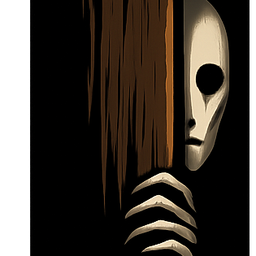
DON'T LET HIM IN Monster Behavior: Circling, Searching, and Light Response
How the DON'T LET HIM IN threat circles the house, opens doors and windows, cuts the power, and reacts to light — and the defensive response each behavior calls for.
DON'T LET HIM IN's monster behavior is a loop, and every stage of it is readable from inside the house: the threat circles the building, studies how you play, and hunts for one unguarded way in. The official copy warns that it "can reach the doors, windows, and even the second floor." Surviving a night is therefore a reading job — each outside behavior gives you a cue, and each cue has a specific counter. Miss the cue and it gets inside, where "the house goes dark." Hold out until 6:00 a.m. and you win.
The tutorial boils the night down to three reflexes this guide builds on. When you hear him at the door or the window, "look right at him, shut it, and turn on a flood light." When you need to disappear, "Hide in a closet. Don't let him see you get in." And all night long: "Watch your noise."
The outside pressure loop
Every night runs the same shape. It opens with an emergency alert: "Residents are urged to remain indoors until sunrise. Do not investigate unusual sounds outside your home." From that moment until 6:00 a.m., the threat circles the house and probes for an entrance — the tutorial's framing is "he comes at night. Every night he tries to get into the house, keep him out until 6:00 a.m."
There are only two endings. If it gets inside, the house goes dark and the night breaks open (the recovery is below). If the clock reaches sunrise, the pressure simply ends: one group hit 6:00 a.m. and watched the monster run away, and another's sunrise was just "Oh, the sun's up... We won." This loop plays out across the creature nights — one player summed up his Boiled One run as "Same thing as the Locust, but now against The Boiled One." For the whole night laid out step by step, see the walkthrough.
Circling: every level is in range
While it circles, it moves over the house, not just around it. Players catch it climbing the walls — "Yo, this guy was climbing up the wall, buddy. You think you're Spider-Man?" — and getting onto the roof: "This guy just climbing on the roof," with a second group reacting to the same sight ("He's on the roof... What kind of house is this?"). It also changes floors mid-night: "he went up," "I saw you going up."
The practical takeaway is that upstairs is not a safe floor by default. Second-floor doors and windows are live entrances, which is exactly what the official claim about reaching "even the second floor" means.
Searching: it opens entrances itself
The search is not passive. It does not only wait for you to leave something unlocked — groups repeatedly catch it working entrances open on its own: "He's opening the upstairs main bedroom," "Oh, he's opening doors," "He's opening another window." In a Boiled One night, one player works out that it can even manipulate a door remotely: "I know he can open it from here too, right? Through the door."
So a closed room is a state to maintain, not a guarantee. The taught counter is closing what it opens: "Maybe we should close the window... We can close the windows." The closing and locking interactions themselves are covered in the doors and windows guide.
When an entrance is lost, the game announces it: "Breach active." The demonstrated recovery is a place swap, not a fight — get out, let it leave, come back. One player repeated the plan to himself until it worked: "If he enters, I leave... He enters, I leave. That's it. Oh, it worked." Later, same session: "Once he leaves, I'll fix the fuse and then I'll head back into the house." If it comes to that, the breach survival guide picks up from there.
How much time an opened entrance buys you is not pinned down by the game. One player guessed "you have like 3 seconds before he comes inside" — treat that as one person's estimate, not a rule. The dependable habit is simpler: close anything you hear being opened as soon as it is safe to do so.
The mistakes it punishes
Official copy says it "studies your mistakes," but the game never spells out what it actually learns from you or how one night changes the next. What is documented is which habits visibly cost players:
- Noise. "Watch your noise" has teeth — one player who kept being singled out got the diagnosis straight: "You've been too loud, dude."
- Windows you open yourself. Peeking creates the exact entrance the search is looking for; one player caught himself mid-mistake: "Why am I opening the window? No, close the window."
- Entrances left unclosed after a scare. One group discovered "the door upstairs is open" in the middle of the night — "I closed it. I had time to close it, man" — a reminder to re-check doors after every emergency.
If your answer is hiding instead of confronting, the timing matters as much as the spot: get into the closet before it can see you move. Shelter options are compared in the hiding spots guide.
The cues: footsteps, scratching, and lying audio
You will mostly track the threat by ear. Footsteps are the constant — "I gotta pay attention to where his footsteps are" — and scratching shows up around entrances: "Oh, he's scratching," plus one group's discovery that "somebody's been scratching at the wallpaper."
The catch is that the audio misleads about position. As one player realized after a night of chasing sounds, "the sound does not match up... this guy could be on a whole different side of the house, but it will sound like he's literally right beside you."
That is why the alert's "do not investigate unusual sounds" doubles as tactics. Walking over to check spends your safety on bad information. Listen to narrow down which side it is working, stay quiet, and only approach an entrance to answer it — closing it or scaring the threat off — never just to look.
The power cut
The most disruptive move in the loop: it cuts the power. Sessions note it again and again ("He cut the power"), and restoring it is its own small victory ("Okay, power restored. Perfect."). The official defense line is blunt: "Restore the breaker when the power fails."
Two constraints make the fix dangerous. The fuses are outside, so someone has to leave shelter — one player who ran "to go outside to flip the fuses back on" died before getting there. And you cannot safely do the work while the threat is indoors: "He has to get out of the house so I can do this... He cut the power. He left." So the fix is about timing: track which side it is on, go when it is not between you and the breaker, and if it is inside, wait for it to leave. The breaker and fuse layout are detailed in the power system guide.
How light changes the pressure
Light is the threat's known weakness, in three layers:
- The scare-off. At a door or window: look right at him, shut the entrance, floodlight on. Play bears the tutorial out — "He's here, he's here... Close the door. Turn it on, turn it on" — and players describe it as quick to run off once confronted. Many then keep the light burning: "I'll keep it on, man. I'm gonna leave these lights on."
- The standing defense. The official trio: "Keep the floodlights powered. Watch the doors and windows. Restore the breaker when the power fails." Setup details live in the floodlights guide.
- The rule and its limit. The named version of the light rule appears in-game as a hint while facing the Locust: "The locust doesn't breach lit areas." Official copy phrases the deterrent generically — "Light keeps it away, but one vulnerable entrance is all it needs" — so treat light as pressure, not immunity. A lit house with one forgotten window still loses. Creature-specific rules belong on the creature pages: the Locust, The Boiled One, and the full monsters roster.
One light works against you: the tutorial is explicit — "Turn off your flashlight. He can see it." A lamp you hold is for finding your way; a light the threat can see is a marker. The flashlight guide covers the item itself.
Behavior-to-response quick reference
| What you notice | What it means | Your response |
|---|---|---|
| The threat at a door or window | It is working that entrance | Look right at it, shut the entrance, turn on the floodlight — or hide in a closet without letting it see you get in |
| Footsteps or scratching, possibly sounding right beside you | It is circling and probing; audio can point the wrong way | Stay quiet, do not investigate, track which side it is on |
| A door or window opening by itself, on any floor | It is making its own entrance | Close it as soon as it is safe, including upstairs |
| "Breach active" — the house goes dark | It is inside | Leave, wait for it to exit, then re-enter and repair |
| The power cuts out | It is forcing the house into darkness and someone outside | Restore the breaker when you can reach it safely; keep the floodlights powered |
| Your flashlight is on where it can see | It can see you | Turn it off |
Every behavior above comes back to two questions: which entrance is it working, and is the matching answer ready? If your nights keep failing at one specific step — a window you cannot hold, a breaker you cannot reach, a breach you cannot recover from — the entrance, power, and creature guides linked above each take over exactly where this behavior loop stops.
Related Guides
Doors and Windows Defense
Which entrances the creature uses, the warning cues to watch, and the actions that keep him out.
Floodlights and Scare-Offs
How the look-shut-light scare-off works and what to do when the creature cuts the lights.
Monster Roster Overview
The verified monster list with the shared 6 a.m. siege plan and a guide link for each threat.